"Closing the Survival Gap: World Sickle Cell Day 2026" By Hamu Madzedze-Online Health and Gender Editor
Updated: Jun 19
Today June 19, 2026 marks World Sickle Cell Day landmarks from New Haven to Wilmington low red. Blood drives, symposiums, and community events are spanning around the globe.
Today is World Sickle Cell Day and is being held under the theme"Closing the Survival Gap: Equity in Sickle Cell Care."
Why Buildings Are Lit Red Tonight
If today one sees a building lit red today, it’s part of the "Shine the Light on Sickle Cell"campaign now in its eighth year.
Red is the campaign’s signature color because it symbolizes urgency, passion, and unwavering determination in the fight against Sickle Cell Disease. The red illuminations are a public commitment to closing the survival gap and ensuring equity in care for every warrior.
What the Theme Means
The theme emphasizes the urgent need to ensure equal access to healthcare services, early diagnosis, treatment, and long-term support for individuals living with Sickle Cell Disease.
It calls on governments, healthcare institutions, researchers, and communities to address disparities in healthcare systems and improve survival outcomes regardless of geographic location, socio-economic status, or background.
Why Equity Matters in 2026
Sickle Cell Disease is one of the world’s most common inherited blood disorders. According to the American Red Cross, individuals living with SCD may require frequent blood transfusions throughout their lives to reduce pain, prevent complications, and improve quality of life. Some warriors may require up to 100 units of blood annually.
Yet access to diagnosis and care remains unequal. The "survival gap" refers to differences in outcomes based on where patients live and what resources they can access.
Global Momentum Today
The "Shine the Light on Sickle Cell" campaign raises awareness of SCD, supports sickle cell warriors and their families, and advocates for improved access to care and a universal cure.
The campaign has been organized by SiNERGe, a collaborative supported by the federal Health Resources and Services Administration.
How To The Close the Gap
The campaign highlights the ongoing need for blood donations. It also underscores that equity means:
1. Early diagnosis accessible to all communities
2. Treatment options available regardless of location
3. Long-term support for warriors and families
Red lights will turn off at midnight but the work to close the survival gap continues.
Equity in sickle cell care cannot wait .Sickle cell disease is no longer a rare disorder tucked in textbooks. It is a global health emergency, and Africa carries the heaviest weight of it.
The World Health Organization reports that 7.74 million people were living with sickle cell disease worldwide in 2021, a 41.4% increase from 5.46 million in 2000. That same year, 515,000 babies were born with the condition,13.7% more than in 2000. Eighty percent of those births happened in sub-Saharan Africa. In countries like Cameroon, Ghana, Nigeria, Gabon, and the Democratic Republic of Congo, between 20% and 30% of the population carry the sickle cell trait. In parts of Uganda, that figure reaches 45%. Nigeria, India, and the Democratic Republic of Congo together account for about 90% of the world’s sickle cell disease population. These numbers are not abstract. They are classrooms where a child misses weeks to pain. They are families deciding between food and transfusion. They are funerals that should never have happened.
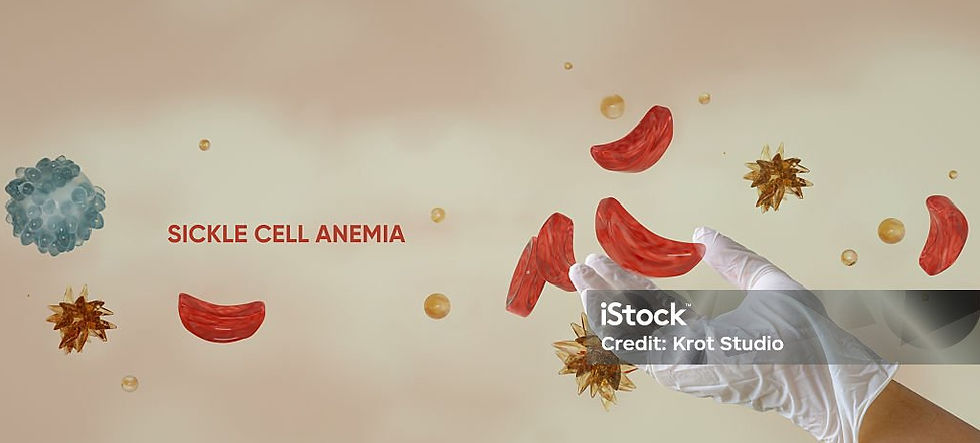
At the centre of this disease is a single change in our genetic code. Sickle cell anaemia begins with the HBB gene. HBB stands for Hemoglobin Subunit Beta.Think of it as the instruction manual your body uses to build beta-globin, one of the two protein chains that form hemoglobin , the molecule inside red blood cells that picks up oxygen in your lungs and delivers it to your brain, heart, kidneys, and every tissue. A mutation in the HBB gene changes just one letter of that instruction. That tiny spelling error produces abnormal hemoglobin called HbS, or sickle hemoglobin. Under stress, cold, dehydration, infection, or low oxygen HbS makes red blood cells collapse into rigid, crescent or “sickle” shapes. Instead of sliding through blood vessels, they stack, rupture, and block flow. Organs are starved. Pain erupts. Damage accumulates. If one inherits one mutated HBB gene, they can have sickle cell trait and usually live symptom-free but if they inherit two, one from each parent, sickle cell anaemia arises.
The complications are as brutal as they are relentless. Children suffer strokes that steal speech and movement before age ten. Acute chest syndrome mimics pneumonia but kills faster, as sickled cells choke the lungs. Kidneys fail. Eyes lose sight. Legs develop ulcers that refuse to heal. Chronic anaemia leaves warriors exhausted before the day begins. And the pain caused by microvascular occlusions is not “in their head.” It is real, it is severe, and it is recurrent. WHO Africa states it plainly,the majority of children with the most severe form of the disease die before the age of five, usually from infection or severe blood loss. In 2021, sickle cell disease was the 12th leading cause of death in children under five globally. The true toll is even higher. While 34,400 deaths were directly attributed to the disease that year, WHO estimates that sickle cell was a contributing factor in 376,000 deaths. For children under five, 81,100 deaths were linked to SCD. In Africa, mortality for children under five still ranges from 50% to 80%.
Yet this story is no longer one of helplessness. Treatment has moved from crisis management to life transformation. The foundation remains unchanged and lifesaving, penicillin prophylaxis started by two months of age, full vaccination schedules including pneumococcal and meningococcal vaccines, folic acid supplementation, aggressive hydration, oxygen during crises, pain control, and blood transfusions when haemoglobin falls too low. But the revolution is hydroxyurea. This once-a-day capsule increases fetal hemoglobin, the kind babies use in the womb, which prevents sickling. It reduces pain crises, cuts hospitalizations, prevents acute chest syndrome, and protects organs. WHO Africa’s 2024 guidance now urges every country to scale up hydroxyurea as part of integrated, holistic care. Dr Matshidiso Moeti, WHO Regional Director for Africa, described the guidance as “tailored to the African reality, where a multi-faceted approach is key.”
For some, cure is possible. Bone marrow or stem cell transplants replace the faulty blood factory with a healthy one, but donor matches are rare and costs are high. Gene therapy and gene editing, recently approved in high-income countries, go straight to the source they fix or bypass the mutated HBB gene. Voxelotor, crizanlizumab, and L-glutamine are newer drugs that reduce sickling, prevent blood vessel blockage, and lower oxidative stress. The challenge now is not science. It is equity. As WHO notes, “significant challenges remain in ensuring equitable access to these treatments in low- and middle-income countries.”
A cure on paper means nothing if a mother in some remote part of a country rural cannot ccess a blood test.
So how is sickle cell anaemia detected? is the question that is asked by many .It starts with knowing what to test and when. The most common screening tool is the sickling test or sickle solubility test. A drop of blood is mixed with a chemical that reduces oxygen. If HbS is present, the blood turns cloudy as cells sickle. But this test cannot tell the difference between sickle cell trait and sickle cell disease, and it misses newborns who still have fetal hemoglobin. For definitive diagnosis, hemoglobin electrophoresis is the gold standard. This lab test separates different types of hemoglobin in the blood using an electric current. It shows exactly how much HbS, HbA, HbF, and HbC a person has. The result tells you if someone is AA, AS, SS, SC, or has another variant. High-performance liquid chromatography, HPLC, is another highly accurate method. HPLC passes blood through a pressurized column that separates and quantifies each hemoglobin type with precision. It is fast, reliable, and the preferred method for newborn screening programs worldwide because it detects HbS even when fetal hemoglobin levels are high. For families with a known history, DNA testing can detect the specific HBB gene mutation directly. This is done through PCR or gene sequencing from a blood sample or cheek swab.
Detection must start early. Newborn screening is the most powerful intervention. In many countries, a heel-prick blood spot is taken in the first 72 hours of life and tested by HPLC or electrophoresis. WHO and hematology associations recommend universal newborn screening in high-burden regions because starting penicillin by two months of age cuts under-five deaths by up to 70%. For adults, prenatal diagnosis is possible through chorionic villus sampling or amniocentesis, which test fetal DNA for the HBB mutation.
Premarital and preconception genotype screening uses hemoglobin electrophoresis or HPLC to tell couples if they are both carriers before they have children. In populations where up to 40% carry the trait, this test prevents two carriers from unknowingly risking a child with SS disease. A full blood count is also critical. It won’t diagnose SCD, but low hemoglobin, high reticulocyte count, and abnormal red cell indices raise the flag for further testing.
The tools exist. The science is settled. What remains is access and urgency. Because every test done early is a crisis prevented. Every genotype known is a child protected. Every child screened at birth is a life given the chance to reach adulthood.


Comments